
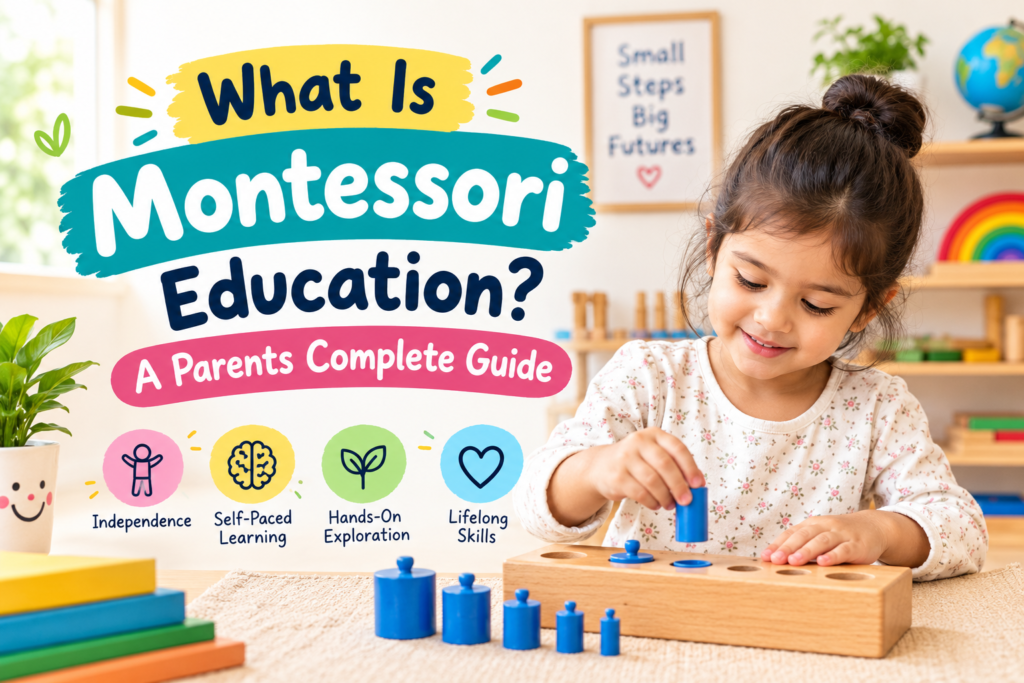
If you have started searching for a preschool chances are you have heard the word Montessori more than once.
Maybe a school says it follows the Montessori method.
Maybe another one says it uses Montessori materials.
And you start wondering. What does all of this actually mean?
Is Montessori just about wooden learning materials?
Do children get to choose whatever they want?
Is there a teacher in the classroom?
Most importantly is Montessori education really suitable for a young child?
These are reasonable questions.
Montessori education has been around for than a century but the basic idea is surprisingly easy to understand when you look at what happens inside the classroom.
Children are given opportunities to do things for themselves explore at their pace and learn through real experiences.
Lets look at what that means in terms.
So What Is Montessori Education?
Montessori education was developed by Dr. Maria Montessori, an Italian doctor and educator.
She spent a deal of time observing children and noticed something interesting. Children are naturally curious and often want to do things independently.
Think about a toddler insisting on putting on their shoes.
Wanting to pour their own water.
Getting upset when an adult tries to help.
Adults may see these moments as struggles.
Montessori sees something in them.
That desire to do things independently can become part of learning.
A Montessori classroom is therefore designed to give children opportunities to try, practise and gradually become more confident in doing things themselves.
What Does a Montessori Classroom Look Like?
It may not look like the classroom many parents remember from their childhood.
Of rows of desks and everyone doing the same worksheet you may see children working on different activities.
One child might be sorting objects.
Another may be working with numbers.
Someone else could be practising pouring or arranging materials.
The shelves are usually organised and materials are placed where children can reach them.
There is a reason for this.
The environment is designed around the child.
Children are expected to choose activities use them carefully and return them when they are finished.
So while the classroom may look relaxed there is actually quite a bit of structure behind it.
Children Learn Through Their Hands
One of the things that makes Montessori interesting is the emphasis on hands-on learning.
Let’s say you want to teach a child about size.
You could show them a picture of objects. Explain which one is bigger.
You could give them objects of different sizes and let them arrange them.
The second experience gives the child something to figure out.
They can see the difference.
They can touch the objects.
They can make a mistake. Rearrange them.
That kind of experience can make an abstract idea easier for a young child to understand.
This is one reason Montessori materials are carefully designed.
They are not there to keep children busy.
Independence Is More Than “Doing Things Alone”
When Montessori talks about independence it doesn’t mean leaving children completely on their own.
It means giving them opportunities to try.
- A child may be encouraged to:
- Pour their own water
- Put their belongings
- Choose an activity
- Carry and arrange materials
- Wash their hands
- Button or zip clothing
- Clean up after an activity
Some of these things may take longer when children do them themselves.
That’s okay.
The purpose isn’t to finish
It is to give the child a chance to practise.
When they finally manage something they couldn’t do a few weeks ago you can see the difference in their confidence.
What Are Montessori Practical Life Activities?
You may hear this phrase when talking about Montessori.
“Practical life” simply refers to activities connected to life.
- Pouring
- Folding
- Transferring objects
- Washing
- Sorting
- Opening containers
- Buttoning
- Cleaning
At first parents sometimes wonder why these things are part of preschool.
Think about what a child is actually doing.
They are using their hands carefully.
They are concentrating.
They are following steps.
They are coordinating their movements.
They are learning to finish a task and put things back.
These are skills for a young child.
And there is something satisfying about being able to say “I did it myself.”
What Are the Benefits of Montessori Education?
Montessori learning can support areas of a childs development.
It encourages concentration
Children can spend time working on an activity of constantly moving from one task to another.
It builds independence
Children get opportunities to manage small tasks on their own.
It supports fine motor skills
Activities such as pouring, threading, transferring and arranging objects require controlled hand movements.
It encourages problem-solving
Children can try ways of completing an activity rather than immediately waiting for an adult to give them the answer.
It can build confidence
Successfully completing something independently can be a deal for a young child.
It encourages responsibility
Children learn that materials need to be handled and returned after use.
None of these things happen after one activity.
They develop gradually through repetition.
Why Do Montessori Activities Get Repeated Often?
You may notice a child doing what appears to be the activity again and again.
An adult might think, “They already know how to do this.”
Children don’t always see repetition as boring.
They are practising.
The time they may spill the water.
The second time they spill less.
A few attempts later they may be able to do it without thinking much about it.
That repeated practice can help children become more confident and precise.
What Role Does the Teacher Have?
This is another area where Montessori can be misunderstood.
Because children may work independently some people assume the teacher simply watches.
That’s not the case.
The teacher observes the children closely.
They introduce materials.
They demonstrate how an activity works.
They notice when a child is ready for something challenging.
They step in when help is needed.
Sometimes importantly they know when not to step in.
If a child is struggling but still trying, immediately doing the task for them may take away the opportunity to figure it out.
A good teacher knows the difference between helping and taking over.
Does Montessori Mean There Are No Rules?
Definitely not.
There are rules and boundaries.
Children learn how to carry materials how to use them properly how to respect another childs workspace and how to return things when they are finished.
They have freedom. That freedom comes with responsibility.
You could think of it as:
“You can choose what you want to work on. You also need to take care of it.”
That balance is a part of Montessori.
Montessori vs Traditional Education
There is no need to treat this as a competition.
Traditional education and Montessori education simply approach learning
A traditional classroom may have teacher-led lessons and activities completed by the whole class together.
A Montessori classroom generally gives children opportunities to choose activities and work independently with hands-on materials.
Neither description tells you everything about a school.
Two schools can both call themselves Montessori. Still have very different classroom environments.
That’s why parents should look at what happens in the classroom rather than choosing based only on a label.
What Age Is Montessori Education Suitable For?
Montessori principles can be introduced during the years.
The activities, materials and level of independence will naturally change as children grow.
A younger child may spend time exploring movement, sensory materials and simple practical activities.
Older preschoolers may begin working with complex language, mathematics and other learning materials.
The important thing is that the activity matches the child’s stage.
Is Montessori Right for Every Child?
Not necessarily.
That’s okay.
Every child has their personality.
Some children love having choices.
Some enjoy repeating activities.
Some are naturally independent.
Others need encouragement and adult support.
Instead of asking whether Montessori is “the best” approach it may be more useful to ask whether the particular Montessori environment is a good fit for your child.
Visit the school.
Observe a classroom.
Talk to the teachers.
Ask how they support children who need guidance.
That will give you a clearer answer.
Can Montessori Be Used at Home?
You don’t need to buy Montessori materials to bring some of the ideas into your home.
Start with things.
Give your child a responsibility.
Maybe they can put their books back on the shelf.
Help set the table.
Water a plant.
Sort socks.
Put toys into their box.
Pour water into their cup with your supervision.
It may be tempting to jump when they take too long.
Sometimes you should.
When you have the time, let them try.
You may be surprised by how much they can do.
One Important Thing Parents Should Remember
Montessori is not about making children independent as quickly as possible.
It is about giving them opportunities to become independent.
There will be spills.
There will be mistakes.
There will be days when your child refuses to do something they managed perfectly yesterday.
That’s childhood.
The aim isn’t to create an organised little adult.
It is to help children gradually develop confidence in their abilities.
Montessori, at IVIRA Global Preschool
IVIRA Global Preschool in Tirupati uses a learning style that is inspired by the world. It includes Montessori, Reggio Emilia, IB philosophy, Finnish education and learning through play.
For parents who are looking into Montessori education it is important to understand this approach.
Of just checking if a school has Montessori items, think about how children are given chances to explore, decide, talk, make and learn through daily life.
When you go to IVIRA you can ask the teachers how Montessori ideas are used in the classroom and how they fit with ways of teaching.
This kind of talk will help you understand more than a simple explanation of Montessori.
What Should Parents Look For in a Montessori Preschool?
If you are thinking about Montessori for your child look past the name.
When you go to the school check things like:
- Are the items placed where children can reach them?
- Do children have chances to make decisions?
- Do teachers let children try things on their own?
- Is the classroom quiet and well-organized?
- Are there activities that help with life?
- Are children taught to look after their space?
- Do teachers pay attention to children?
- Are there limits?
- Do children appear happy and interested?
Also remember to watch the teachers.
The way an adult talks to a child can show a lot about the schools way of thinking.
Final Thoughts
Montessori can seem hard to understand at first.
Spend some time watching a child work in a Montessori setting and the idea becomes easier to see.
A child pours water.
They spill some.
They try again.
They put the item back.
Then they pick something
It looks simple.
Behind that simple action are focus, movement, patience, making choices and being on their own.
That is what makes Montessori special.
It does not push children to act like grown-ups. Instead it gives them a chance to practice things they naturally want to learn.
If you are thinking about Montessori for your child do not just read about it.
Go to a classroom.
Ask questions.
Watch the children.
See if the place feels like a place where your child would like to learn.
Frequently Asked Questions
What is Montessori education?
Montessori education is a way of learning where children explore and learn by doing. Teachers help children as they work and find things on their own.
How is Montessori different from education?
Montessori often gives children choices and chances to work on their own with real items. Regular classrooms may focus more on lessons led by the teacher and group work.
What are the good parts of Montessori learning?
Montessori can help with focus being on their small hand movements solving problems, confidence and taking responsibility through daily tasks and repeating things.
What age is right for Montessori learning?
Montessori ideas can be used when children are very young including preschool. The activities should match the child’s age. How they are growing.
Does Montessori mean children can do anything they want?
No. Children have choices. Those choices are inside clear rules. They are expected to use items, be kind to others and take care of their space.
How does IVIRA use Montessori ideas?
IVIRA Global Preschool uses Montessori as part of a learning style that includes Reggio Emilia, IB philosophy, Finnish education and learning through play. Parents can visit the school. Talk with the team to see how these ideas are used in daily teaching.