
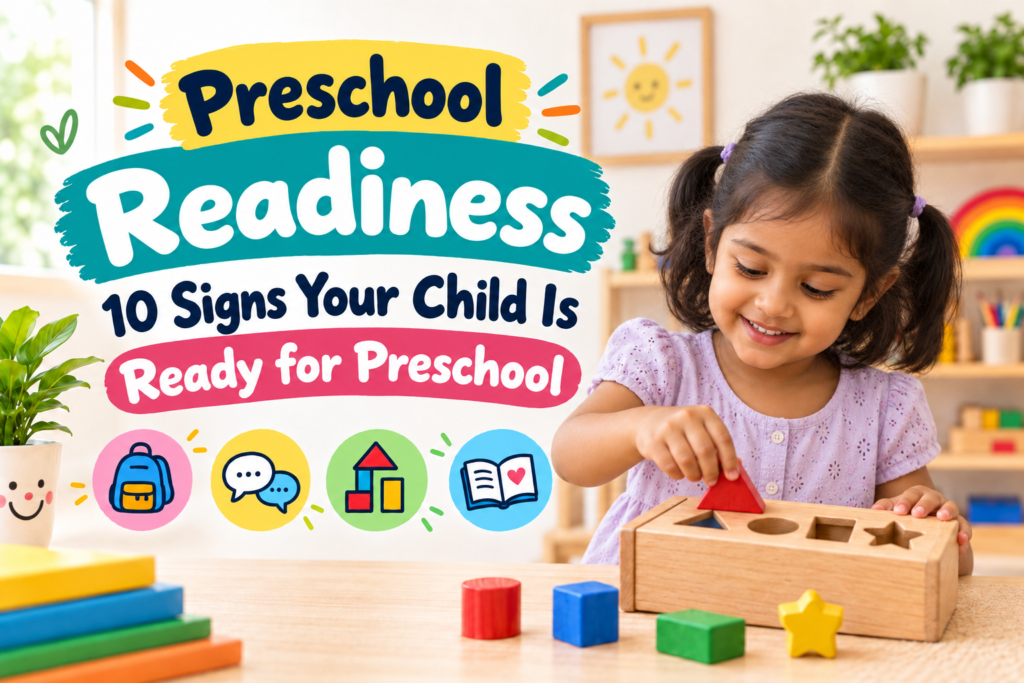
At some point you may begin to ask yourself “Is my child truly ready for preschool?”
Maybe your child has begun asking to follow you. Maybe they are curious about kids.. Maybe they have become very independent and want to do everything on their own.
At the time you may have doubts. Will they manage without me? Will they eat well? What if they cry when I leave?
These are normal questions. Preschool readiness is not about whether a child can read, write or count. It is about whether they’re slowly building confidence and everyday skills that let them feel at ease in a new setting.
Here are signs parents can look for.
1. Your child is curious about children
Does your child watch other children playing and try to join them?
They may not yet know how to share or take turns. That is fine. Simply showing interest in children is a good sign.
Preschool offers children chances to learn how to play with others, make friends and gradually understand simple social rules.
2. Your child can communicate their needs
Your child does not need to speak perfectly.
Being able to say things like “I am hungry ” “I need water ” “I want to go ” or “I need help” is already useful.
Being able to communicate with teachers makes the preschool experience much easier for your child.
3. Your child can follow instructions
Can your child follow directions such as:
“Keep your toys here.”
“Come and wash your hands.”
“Put the book on the table.”
These small instructions matter because a preschool classroom involves little routines throughout the day.
4. Your child is becoming comfortable doing things
Perhaps your child wants to put on their shoes, carry their bag or eat without being fed.
They may still need help of course. Independence develops gradually.
Simple things like putting toys, washing hands or trying to open their lunch box become valuable skills for preschoolers.
5. Your child can stay with an activity for a while
Preschoolers are not expected to sit quietly for an hour.
But if your child can listen to a story, complete a simple puzzle, colour a picture or play with blocks for a few minutes they are already building an important skill.
Attention grows with practice.
6. Your child is beginning to understand routines
Children usually feel more comfortable when they know what happens next.
If your child understands routines such as waking up, getting dressed, eating breakfast and leaving the house they may find the transition to preschool easier.
A predictable routine at home can help too.
7. Your child can manage periods away from you
This is a big one for many parents.
Your child may be happy playing with grandparents or another trusted adult but become upset the moment you leave.
That does not automatically mean they are not ready.
Some children simply need time to become comfortable with separation. The important thing is that they gradually learn that you leave and come back.
8. Your child shows interest in books, stories or songs
Your child does not need to recognise every letter before preschool.
Enjoying picture books, listening to stories, singing songs or repeating rhymes are all early learning experiences.
These activities naturally build listening, language and vocabulary.
9. Your child can express emotions
“I am angry.”
“I do not like this.”
“I am scared.”
Being able to express feelings imperfectly is helpful.
Children are still learning how to handle emotions but recognising and talking about those feelings is an important part of preschool readiness.
10. Your child is ready to explore
The biggest sign is simply curiosity.
Your child may want to know what is inside a box, why something works, what another child is doing or what happens when they mix two colours.
That natural curiosity is something preschool can build on every day.
What if my child does not show all these signs?
Do not turn this into a checklist where your child needs to tick every box.
Children develop at speeds. One child may be very independent but shy around children. Another may be highly social. I still need help with everyday tasks.
The goal is not to make your child “preschool perfect.”
The goal is to help them feel secure enough to explore, communicate, try things and slowly become more independent.
How can parents prepare a child for preschool?
Start with things.
Let them put their toys away. Give them choices. Read together. Visit places. Encourage them to talk about how they feel.
Give them time to interact with children.
You do not need a preschool workbook for this.
A lot of preparation happens naturally during family life.
FAQs
What is readiness?
Preschool readiness refers to the communication, emotional, physical and everyday skills that help a child adjust to an environment
At what age should a child be ready for preschool?
There is no perfect age for every child. Readiness depends on the child’s development, confidence and the type of programme
What if my child cries when I leave?
Crying during separation is common during the few days. A goodbye routine and consistent reassurance can help
Does my child need to know the alphabet before preschool?
No. Familiarity with books, songs, sounds and conversations is more important, than expecting a preschooler to already read