
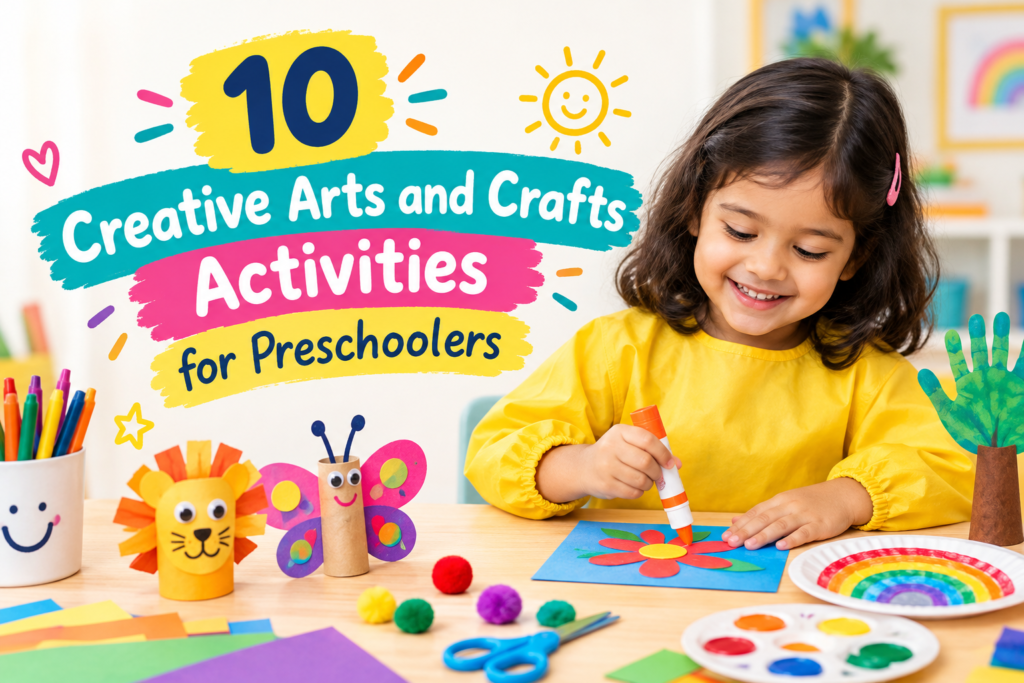
If you ask a preschooler to sit down with a blank sheet of paper and a few colours and you never really know what is going to happen next.
One child might draw a house. Another might create a monster. Someone else might simply cover the page with lines and dots.
Honestly that’s the fun of it.
For children the art is not only about creating anything which is perfect, but it is also about trying, exploring, making choices and expressing what is happening in their minds.
That is why the arts and crafts can play such a role in early childhood learning for your children. A simple activity can help children develop their motor skills, imagination, confidence, communication and ability to think independently and decide on what is good and what is not.
The best part? You don’t need materials or expensive toys to get started.
Check out 10 arts and crafts activities for preschoolers that can turn everyday materials into meaningful learning experiences.
Why Are Arts and Crafts Important for Preschoolers?
Before getting into the activities lets talk about something parents often overlook.
When a child is painting, tearing paper, pressing clay or creating something from scratch they are doing more than “making a craft.”
They are learning to:
- Use their hands and fingers with greater control
- Concentrate on a task
- Make independent choices
- Express their thoughts and feelings
- Explore colours, shapes and textures
- Solve problems
- Use their imagination
- Feel proud of something they created
This is why arts and crafts for preschoolers can be an important part of early childhood development.
Not every activity needs to have a finished product.
Sometimes the exploration itself is the learning.
1. Ice Painting
What if your paintbrush could melt?
Ice painting is a simple activity that gives children an entirely different way to experience art.
Freeze water into small ice cubes or suitable ice shapes. Give the children a sheet of paper. Let them move the coloured ice across the surface.
As the ice melts the colours begin to spread and leave patterns behind.
Children can observe:
How ice feels
How it melts
How colours move
What happens when colours mix
How different movements create marks
It becomes a combination of art and sensory exploration.
Children usually don’t need much encouragement to keep experimenting once they discover what the ice can do.
What it develops: awareness, creativity, colour recognition and observation.
2. My Favourite Things – My Plate, My Choice
Give each child a paper plate and one simple instruction:
“Fill your plate with things you love.”
That’s it.
One child might draw their food. Another might draw a pet. Someone else might choose a toy, colour, person or place.
There is no template to copy and no “correct” plate.
The activity gives children the freedom to make their choices while encouraging them to talk about what they have created.
You can ask:
“Why is this your favourite?”
“Tell me about this picture.”
“What would you like to put on your plate?”
A simple art activity becomes a conversation about the Childs interests and experiences while learning.
What will it develop? Self expression, decision making, communication and creativity for children.
3. Self-Portrait
Children spend plenty of time looking at the people around them. How often do we ask them to really look at themselves?
A self-portrait activity gives them that opportunity.
Let children look at themselves in a mirror and create their picture.
They might notice their:
- Hair
- Eyes
- Nose
- Smile
- Clothes
- Favourite features
Don’t worry about whether the portrait looks realistic.
A preschoolers drawing isn’t supposed to look like a photograph.
The important part is that the child is observing, thinking and trying to represent themselves in their way.
You can even revisit the activity after a months and let children create another self-portrait. It can be fascinating to see how their drawings and ideas change.
What it develops: Self-awareness, observation, creativity and fine motor skills.
4. Push and Pull Ribbons Through the Hole in the Box
Sometimes the simplest activities can be surprisingly engaging for children.
Take a cardboard box. Make a few suitable-sized holes. Give children ribbons. Encourage them to push the ribbons through the holes and pull them back out.
It sounds simple. Their little hands have to work carefully to make it happen.
They need to coordinate what their eyes see with what their handsre doing.
They also get the opportunity to repeat the action, experiment and figure out how the ribbon moves.
This makes it a great fine motor skills activity for preschoolers.
What it develops: Finger strength, hand-eye coordination, concentration and fine motor control.
5. Tree Printing
Trees are around us but children can experience them differently through art.
With tree printing children can use materials and printing techniques to create their own trees.
They can experiment with the trunk, branches, leaves and different textures to see what kinds of marks they can make.
Of asking everyone to make an identical tree let them create their own version.
A teacher or parent can also use the activity as an opportunity to talk about nature.
Why do trees have leaves?
What colours can leaves be?
What happens to leaves when seasons change?
This turns an art activity into a small exploration of the natural world.
What it develops: Creativity, observation, colour awareness and connection with nature.
6. Friends Map
Art can also help children understand their relationships with the people around them.
For a Friends Map children can create a visual representation of themselves and their friends.
They might draw themselves in the centre. Add their friends around them or use pictures, symbols or other creative materials to represent their classroom relationships.
While creating the map children can talk about:
- Who they like playing with
- What games they play
- What they enjoy doing with their friends
- How they can be a good friend
- This makes the activity more than just drawing.
It encourages children to think about friendship, belonging and relationships.
What it develops: emotional skills, communication, self-expression and awareness of relationships.
7. What Shall I Make?
This might be one of the important questions you can ask a preschooler:
“What shall I make?”
Give children different materials. Paper, cardboard, colours, shapes or other safe craft materials. And let them decide what they want to create.
Don’t show them an example.
Don’t tell them what it has to look like.
Let them figure it out.
Maybe one child makes a house.
Another makes an animal.
Someone else creates something that doesn’t have a name.
That’s perfectly fine.
Ended activities like this give children the freedom to think for themselves rather than simply reproduce someone elses idea.
Sometimes you’ll be amazed by what they come up with.
What it develops: Imagination, creativity, decision-making, problem-solving and independent thinking.
8. Stone Painting
A stone may look like a stone to us.
To a preschooler it can become anything.
With child- paints and suitable stones children can turn ordinary stones into colourful characters, animals, patterns, flowers or anything else they imagine.
You can even give them a challenge:
“Can you turn this stone into something?”
The answer is entirely theirs.
Stone painting also introduces children to a texture and surface encouraging them to notice how paint behaves differently on different materials.
What it develops: Creativity, sensory exploration, imagination and fine motor control.
9. STEAM – Obstacle Path
Not all creative learning happens while sitting at a table.
A STEAM obstacle path can bring movement, thinking and problem-solving together.
Create a path where children need to step over move around crawl under, balance or navigate through different obstacles.
You can introduce challenges along the way:
“Can you find another way around?”
“What happens if we move this obstacle?”
“Which path is easier?”
Children are not only moving their bodies. They are observing, making decisions and figuring out how to reach the side.
It is an example of how STEAM learning and physical play can work together in early childhood.
What it develops: Problem-solving, coordination, spatial awareness, confidence and physical development.
10. Clay Imprint
There is something about clay that children naturally enjoy.
They can squeeze it roll it press it flatten it and turn it into something new.
With a clay imprint activity children can press objects or textures into clay and observe the marks they leave behind.
A leaf might create one pattern.
A textured object might create another.
Even a childs fingers can create shapes.
You can encourage children to compare the imprints and talk about what they see.
“Which one is rough?”
“Which pattern is bigger?”
“What happens when you press harder?”
This makes clay a material, for both creative and sensory learning.
What it develops: motor skills, sensory awareness, creativity, pattern recognition and curiosity.
How Arts and Crafts Help Develop Fine Motor Skills
One of the benefits of preschool art activities is something you may not immediately notice.
The little movements.
When a child:
- Tears something
- Holds a crayon
- Presses clay
- Moves a paint tool
- Pulls a ribbon
- Makes an imprint
- Places materials carefully
their fingers and hands are constantly working.
These movements help children practise motor control and hand-eye coordination.
Over time these skills can support activities such as using utensils dressing independently and eventually developing the control needed for writing.
So when your child is happily covered in paint or squeezing clay between their fingers there may be more learning happening than meets the eye.
Let Children Create Without Trying to Make It Perfect
This is perhaps the important tip for parents.
If your child paints a tree let it be purple.
If their self-portrait has three eyes don’t immediately correct it.
If their “house” looks nothing like a house ask them about it.
Try saying:
“Tell me about what you made.”
Instead of:
“Thats not how a house looks.”
For young children creativity is about exploration, not accuracy.
When adults focus much on the final result children can start worrying about whether they are “doing it right.”
When they are given the freedom to experiment they learn something more valuable:
“I can have my own ideas.”
How Parents Can Encourage Creativity at Home
Parents do not need an art room at home.
A small box of materials can be enough.
Keep paper, crayons, cardboard, clay and other safe craft items within reach.
Parents can also add items that children can explore in many ways.
Materials Parents Can Keep at Home
Basic art materials
– Paper and coloured paper
– Crayons and child‑safe pencils
– Washable paints
– Clay. Play dough
– Child‑safe scissors
– Glue
Natural materials
– Shells
– Smooth stones
– Sticks
– Pine cones
– Leaves
Recycled and everyday materials
– Bottle caps
– Cardboard tubes
– Fabric scraps
– Small cardboard boxes
– Paper rolls
Other useful materials
– Buttons
– Ribbons
– Wooden blocks
– Different shapes and textures that are safe for the child’s age
These materials do not need to become a specific craft every time.
In fact giving children a mix of items without telling them what to make can encourage open‑ended play.
A child might arrange shells and stones into a picture, use bottle caps to make patterns, turn cardboard tubes into something or use ribbons and fabric pieces to create a pretend world.
The goal is not to create something that looks “perfect.”
The goal is to give children chances to touch, explore, combine, arrange, build, create and think of their ideas.
Occasionally give your child a challenge.
Instead of: “Make a flower.”
Try: “What would you like to make today?”
Instead of: “Colour inside the lines.”
Try: “What happens if you mix these colours?”
When you give your child scissors or small items such as buttons, always choose age‑appropriate materials and supervise the activity.
When they finish do not judge the artwork away.
Ask the child to tell you about it.
You may discover that what looks like a collection of colours, stones and buttons actually has a detailed story behind it.
How IVIRA Global Preschool Encourages Creative Learning
At IVIRA Global Preschool creative exploration is treated as a part of a childs early learning journey.
The schools approach draws inspiration from recognized educational philosophies such as Montessori, Reggio Emilia, IB philosophy and Finnish education along with play-based learning.
This creates opportunities for children to learn through hands-on experiences than simply being told what to learn.
Activities such as ice painting, self-portraits, clay imprints, tree printing and ended creation can encourage children to explore materials express their ideas and make their own choices.
The aim is not to make every childs artwork look the same.
It is to give every child the opportunity to create, explore and discover in their way.
For parents this is a distinction when choosing an early learning environment.
A good preschool isn’t about what children learn.
It is also about how they experience learning.
How Parents Can Encourage Creativity at Home
You don’t need an art room at home.
A small box of materials can be enough.
Keep some paper, crayons, cardboard, clay and other safe craft materials within reach. Occasionally give your child an open-ended challenge.
Instead of:
“Make a flower.”
try:
“What would you like to make today?”
Instead of:
“Colour inside the lines.”
try:
“What happens if you mix these colours?”
When they finish, don’t immediately judge the artwork.
Ask them to tell you about it.
You may discover that what looks like a collection of colours actually has a very detailed story behind it.
Final Thoughts
Arts and crafts may seem like activities in a preschoolers day but they can create some pretty big learning opportunities.
A block of ice becomes a paintbrush.
A paper plate becomes a collection of things.
A mirror becomes the starting point for self-expression.
A cardboard box becomes a motor challenge.
A stone becomes a character.
A piece of clay becomes a science experiment.
That’s the beauty of learning for young children.
They don’t need everything to be perfect.
They need the freedom to try, explore make mistakes imagine and try again.
Sometimes the best thing an adult can do is simply step back smile and ask:
“What shall we make today?”
Frequently Asked Questions
Why are arts and crafts important for preschoolers?
Arts and crafts can support creativity, fine motor development, hand-eye coordination, concentration, self-expression, confidence and problem-solving skills in children.
How do craft activities improve creativity?
Craft activities allow children to experiment with materials make their choices and develop ideas. Ended activities are particularly useful because they encourage children to think beyond a single correct answer.
Which craft activities are safe for preschoolers?
Age-appropriate activities such as ice painting, clay activities, self-portraits and supervised painting can be suitable for preschoolers. Always use child- materials and supervise activities involving materials that may not be suitable for independent use.
How do arts and crafts develop motor skills?
Activities such as pressing clay, moving painting tools pulling ribbons and making imprints involve controlled movements of the hands and fingers. These experiences help children practise motor control and coordination.
Can parents do these activities at home?
Yes. Many DIY crafts for preschoolers can be adapted for home using materials. The focus should be on giving children an opportunity to explore and create than expecting a perfect finished product.
How does IVIRA Global Preschool encourage learning?
IVIRA Global Preschool incorporates hands-on and play-based experiences into its early learning approach drawing inspiration from Montessori, Reggio Emilia, IB philosophy and Finnish education. The focus is on encouraging children to explore, create, communicate and develop confidence, as learners.