
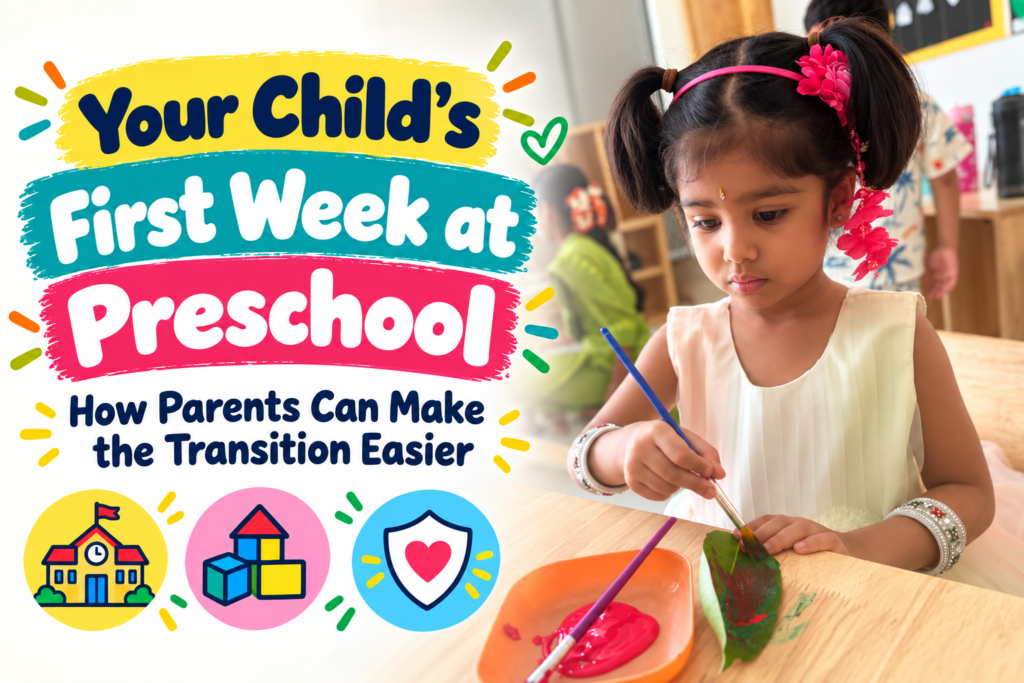
One child walks in like the child owns the place. Another child holds on to the parents hand as if letting go is simply not an option.. Some children do both—confidently enter on Monday and suddenly refuse to go on Wednesday. All of this can be normal.
Starting preschool is a change for a young child. The child is entering a space meeting unfamiliar adults, seeing new children and following routines the child has not experienced before.
So what can parents actually do to make the first week of preschool easier?
Keep mornings calm
Try not to make the morning a race.
Keep clothes, bags and other essentials ready beforehand. Give the child time to wake up eat and get ready.
A rushed morning can make an unfamiliar experience feel even more stressful.
Don’t make goodbye long
This is one of the hardest things for parents.
The child starts crying so the parent stays for another five minutes. Then another five. Eventually the goodbye becomes a 20‑minute negotiation.
A warm but clear goodbye usually works better.
Give the child a hug tell the child when the parent will return and leave confidently.
That does not mean ignoring the child’s feelings. It means showing the child that the parent trusts the child to handle the experience.
Expect some tears
Crying does not automatically mean the child is unhappy at school.
Sometimes it simply means, “I do not want the parent to leave.”
The child can cry at the gate. Then start playing a few minutes later.
Of asking repeatedly “Did you cry today?” try asking:
What did the child play with?
Who did the child meet?
What was funny today?
These questions open up a kind of conversation.
Don’t compare their adjustment with another child
You may see another child happily running into class on day one.
That is that child’s story.
The child may need a week. Another child may need longer.
Comparing the child with another child can make the parent anxious. Can unintentionally make the child feel that the child is not doing well.
There is no prize for settling in first.
Keep the home predictable
During the first week the child may come home tired or slightly irritable.
That is understandable.
Try to keep meals, naps, bedtime and playtime reasonably consistent.
The child is already processing a lot of experiences during the day.
Home can be the part of the child’s world.
Let them talk – or don’t
Some children come home and tell the parent everything.
Others respond to “How was school?” with “Fine.”
Do not force a conversation.
Sometimes the child needs time before the child can explain what the child experienced.
The parent can talk while doing something together—drawing, having a snack or getting ready for bed.
The conversation often comes naturally then.
Give the teacher information
Teachers appreciate knowing about things that may help them understand the child.
For example, does the child take time to warm up to people? Does the child become uncomfortable with sounds? What usually helps when the child is upset?
These small details can make the transition smoother.
Be careful with promises
“Do not worry the parent will never leave the child alone.”
“Do not cry.”
“The child will have the day ever.”
These statements are meant to comfort. They can create expectations that are not realistic.
Instead say something
“You might miss the parents. That is okay. The teacher will be there to help the child and the parent will come back after school.”
That gives the child something to hold on to.
Celebrate progress
Maybe the child entered the classroom without crying.
Maybe the child spoke to a teacher.
Maybe the child opened the lunch box themselves.
Maybe the child told the parent about one activity.
These little moments are progress.
Starting preschool is not one achievement. It is a collection of steps.
What about separation anxiety?
Some children experience preschool separation anxiety especially if this is the child’s regular experience away from parents.
Stay calm and consistent.
Create a short goodbye ritual – a hug, a phrase, a wave at the door – and follow it each day.
If the anxiety continues strongly or seems to be getting worse the parent should speak with the teacher. Discuss what the teacher is observing during the day.
By the end of the week…
The child may still not be completely settled.
That is okay.
The first week is an introduction, not an exam.
With time the classroom starts becoming familiar. Teachers become familiar. Other children become familiar.. Eventually that once‑strange school gate can become part of an ordinary morning.
FAQs
What should I expect during my child’s week of preschool?
Expect some mixture of excitement, curiosity, tiredness and possibly tears. Every child’s adjustment looks different.
How long does it take a child to settle into preschool?
Some children settle within a days while others take several weeks. There isn’t one fixed timeline.
What should I do if my child cries every morning?
Keep the goodbye calm and consistent and speak with the teacher about how the child behaves after the parent leaves.
Should I stay at preschool if my child is crying?
In cases a short and confident goodbye works better, than a prolonged departure but follow the school’s transition approach.