
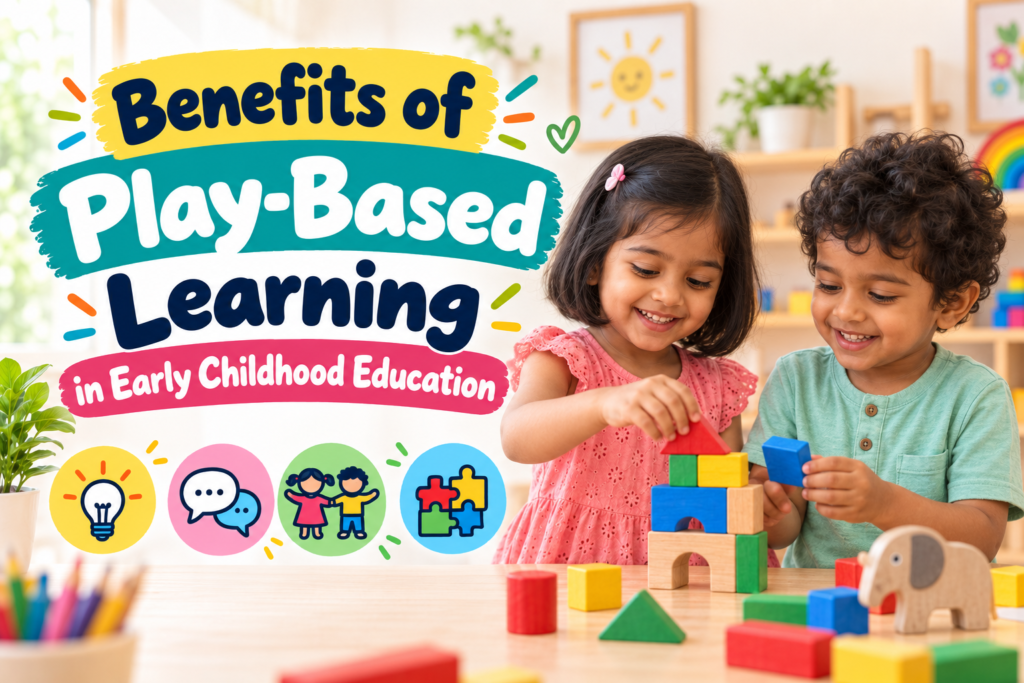
When a group of preschoolers is building a structure with blocks pretending to be in a shop painting with their fingers playing a game it can be easy to think that all they are doing is having fun.
For a child however, play is one of the most important ways to learn. Children. Learn about their environment, communicate and problem-solve, make decisions, express emotions and develop skills while they play.. That is why play-based learning has become an essential part of early childhood education.
For parents the idea of learning through play can be a problem. They think “If all my child is doing is playing then how exactly are they learning?”
The short answer is: children do not start learning in the way that older kids and adults do. They learn through action exploration, experimentation, observation, and experience. Let’s examine what play-based learning is, why it is so important and how it can benefit your child’s early learning experience.
What is Play-Based Learning?
Simply put play-based learning is a learning methodology that focuses on learning through exploration play and guided interactions. However it is important to note that play-based learning includes both child-guided and teacher-guided activities.
A teacher or caregiver might guide a child through an activity using building blocks asking them to build a bridge and then discussing the concepts of size shape balance counting problem-solving teamwork and communication that the child uses to complete the task.
Play-based learning activities allow for discovery, creativity and interaction while teaching a child concepts and skills.
Why is Play-Based Learning Important?
The early years are some of the years in a person’s life. They are constantly. Growing, developing new skills that will impact the rest of their lives. Play is an opportunity for young children to explore experiments and acquire skills and knowledge.
While traditional learning often separates subjects, play can help children develop communication, emotional cognitive motor and language skills at once.
Let’s examine the ways that play can contribute to your child’s development:
1. Play encourages curiosity
From an age children are curious about the world around them and how it works. By asking questions like “What would happen if…” “Why is this…” “What is this…” young children begin to explore their environment. By engaging and encouraging a child’s curiosity you can nurture their desire to learn and gain knowledge.
2. Play develops problem-solving skills
Children love to tinker and experiment! If a tower made of blocks keeps falling down what can they do to fix it? What if they try an approach? How can they ask for help? By playing and experimenting children develop problem-solving skills. These are often the skills that are developed when a child is learning to read or write and can help them succeed later in school
3. Play encourages social development
Children are creatures. They need friends and connections as much as adults do. While group play can certainly be chaotic it helps children to develop skills such as sharing, taking turns listening, communicating, cooperating, compromising and more. For example when children play a restaurant game they often have to work to assign jobs and decide who will be the cook, the customer or the waiter.
4. Play builds communication and language skills
Children will often learn to talk by talking. That means engaging in conversations pretending to be storytelling, singing and listening. By having fun with your child and engaging in conversation you can help them build their listening and communication skills. You can ask your child questions such as “What’re you making?”. What happens next?”
5. Play encourages creativity and imagination
Give a child a cardboard box. What will they do with it? What will they turn it into? The possibilities are endless! By playing, children can explore their creativity. Develop their imaginations. They can express themselves in ways. Think outside the box. This is a skill that children can use to create things, find solutions and explore the world at any age.
6. Play supports emotional development
Emotions are a part of childhood but understanding how you feel and why can be difficult. By playing children can express their emotions in a healthy way. Children can act out scenarios that they have seen or experienced or play out ways that they think that a situation could be resolved. By playing pretend or working together children can also learn more about cues, empathy and emotional communication.
7. Play builds fine and gross motor skills
Children need lots of opportunities to develop their motor skills. Fine motor skills are used in tasks including writing or using utensils to eat. Gross motor skills are needed for activities such as running and jumping. By engaging in activities such as drawing, painting, building, sculpting, threading, activities like cutting with scissors, playing active games, climbing or balancing children can build important motor skills.
8. Play helps children make connections
Children are more likely to learn something if they can experience it by hand. Try giving a child something to count and asking them to show you how items you have asked for (for example “Can you give me three apples?”) rather than just asking them to write numbers. By giving a child an opportunity to experience a concept you can make it more meaningful and easier for them to understand.
Examples of Play-Based Learning Activities
Not all play-based learning activities need be. Require amounts of time or money to set up. Here are some great development-focused activities that you can do with your child:
Building Play
Children can use building blocks to build towers, structures, roads or bridges. Great for developing problem-solving awareness, motor skills and creativity.
Pretend Play or Play-Based Dramatic Activities
Set up a store, a restaurant or a hospital. Let your child explore their creativity and develop social and communication skills.
Puzzles
Puzzles are a way for children to learn to identify patterns and practice problem solving.
Storytelling
Listening to stories and acting them out can help develop language and communication skills, memory imagination and more.
Sensory Play
Playing with water and sand helps children practice pouring measuring motor skills and more.
Creative Art Activities
Let your child’s imagination run wild with drawing, painting, sculpting and more!
Outdoor Play
Physical activity is important for developing both motor skills in young children.
Play-Based Learning Does NOT Mean “No Structure”
For parents one of the concerns about play-based learning is that it means children will simply be left to do as they please all day.
While play-based learning activities do allow children to explore and have fun it is important to remember that a skilled educator will always keep learning goals in mind. The difference between learning and play-based learning is that in play-based learning settings children are able to be creative and have fun while they learn.
The Role of Educators in Play-Based Learning
Many parents wonder what educators do in a play-based learning classroom. In reality excellent educators are always. Interacting with children in order to support their learning and development. Teachers and caregivers can help to build a child’s development by:
- Observing the child’s interests.
- Asking guiding questions
- Offering materials or activities
- Giving support when needed
- Encouraging collaboration
- Connecting play to learning, and more.
If children are playing with toy cars their teacher could talk to them about speed size color counting directions or storytelling. Helping them to make connections between play and concepts.
Play-Based Learning and School Readiness
Some parents worry that play-based learning will leave their child “unprepared” for schooling. The truth is school readiness is much more than knowing letters and numbers. It includes skills in emotional regulation, listening skills, problem-solving communication and more.
By encouraging play-based learning you can support your child’s development while making learning fun and engaging.
Academic concepts can be. Explored through play storytelling activities and more.
The Role of Play-Based Learning in IVIRA Global Preschool
At IVIRA Global Preschool we believe that play is essential to children’s development and education.
The methodology is inspired by philosophies including the Montessori method, the Reggio Emilia approach IB philosophy and Finland’s national education model. All of these philosophies share one goal: to encourage children to explore their world and develop in all areas.
Our play-based learning philosophy encourages children to learn and grow. We believe that the early childhood education experience should prioritize the development of not academic knowledge but creativity, confidence, communication independence and social-emotional skills.
For parents looking for a preschool in Tirupati, it is important to consider their child’s overall learning experience, not just the subjects they will learn.
A great preschool will not ask the question “What will we teach the child?”. Also “How will the child learn it?”
Parents Can Encourage Play-Based Learning at Home
You do not need to have access to educational toys in order to encourage play-based learning at home. Here are a few ways you can encourage play-based learning, with your child:
Cooking and Baking
Ask your child to count ingredients or identify colors and shapes.
Use Cardboard Boxes
Give your child an opportunity to explore and express their creativity. What will they turn the box into?
Encourage Pretend Play
A toy kitchen, a doctor kit or simple household items can spark your child’s imagination.
Read Together
After reading a book ask your child what they thought happened next or what they think the characters are feeling.
Play Outside
Give your child an opportunity to explore the world around them. Running, jumping, balancing and more can help them develop motor skills.
Let Them Solve Small Problems
Rather than rushing to solve every problem, give your child a chance to work through the problem by themselves.
It is very important to play with your child
There is no issue with letting your child take charge of the activity and decide what they want to do. Simple questions like “What’re you making?” can help you ask your child to explain what they are doing. Letting your child take the lead gives them a chance to think in a way and share their thoughts.
What To Look For In A Play-Based Preschool
When you are searching for a preschool for your child make sure to ask about their way of teaching through play.
Ask the school questions like:
- What does a day look like for the children?
- How much time is spent on playing and exploring?
- How do the teachers get involved in playing with the children?
- Are the activities suitable for the childs level of development?
- Are there chances for both independent play?
- How are language and school subjects introduced?
- Are children given chances to play outside?
- How are social and emotional skills taught and supported?
- How does the school watch the children to help their learning?
Even if a school uses the phrase “play-based learning” by watching a classroom you can get a sense of how the school teaches and connects with the students.
What do you see about the children? Are the teachers talking with them? Do they have chances to explore? Is the place interesting?
Final Thoughts
For children, play is learning. When they build, explore, pretend, move, talk, experiment and do things they are gaining important abilities. Through play-based learning teachers can help children build thinking, emotional, communication and movement abilities.
The best early childhood education programs know that young children need chances to learn and grow at their speed. They don’t need to be pushed to become adults. They need to be supported to explore their curiosity, show their feelings, think in a way, ask questions and learn something new every day.
When you are thinking about childhood education it is important to find a program that focuses on more than just school subjects. A good school will let children learn through play and grow into curious future leaders.
FAQs
What’s play-based learning?
Play-based learning is a way of learning that helps children learn through exploring, playing and guided interactions.
Why is play-based learning important?
Play-based learning can help children develop communication, social emotional, thinking, movement and language abilities while making learning fun and meaningful.
How does play help a childs growth?
Play can help children talk, solve problems, make choices, work with others, express themselves and more.
What are examples of play-based learning activities?
Building blocks, role play, puzzles, telling stories, sensory play, art projects, outside play, music and many other things are all examples of play-based learning activities.
How does IVIRA use play-based learning?
IVIRA Global Preschool uses a play-based learning approach that lets children explore take part in activities and build their abilities as learners. The school uses the ideas of Montessori, Reggio Emilia, IB philosophy and Finlands national education model.